
In the first season of the Mendocino Music Festival 40 years ago, there were eight concerts in a small yellow and black striped tent on the headlands. All were classical music, four performed by an orchestra and four by a chamber group. This season, which begins on July 11th, there will be 27 concerts performed in a spacious white tent by a mix of musicians playing and singing every genre from bluegrass to classical, from Celtic to jazz, and from opera to soul.
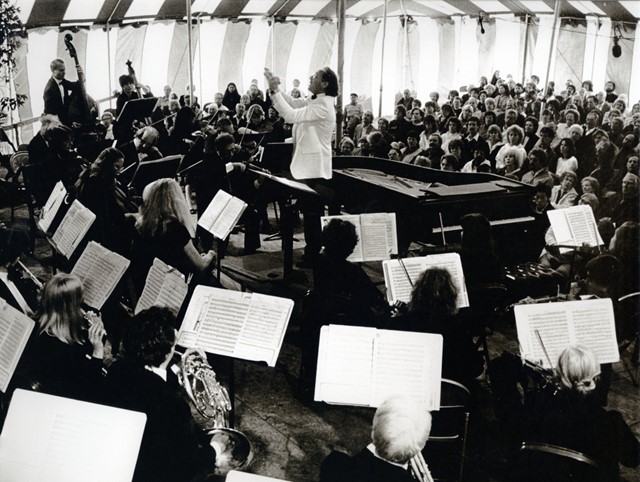
Allan Pollack conducts the Festival Orchestra in the circus tent in 1987.
That the festival has endured and grown is a testimony not only to the universal human delight in music, but also to the large heart of a small town. The festival is a lean operation and would not be possible without the many generous Mendonesians who volunteer to sell the tickets, usher in the tent, perform in some concerts, supply the food and beverages, serve them, house the visiting musicians, work on the board of directors, and donate critical funds for all the necessities.
There are various versions of the festival’s origin story, not surprising given how long ago it happened, but the Kelley House favors the one told by Marcia Lotter, the festival’s Associate Concertmaster and de facto historian, in a 2016 talk she gave at the museum on the occasion of the 30th anniversary. The festival’s roots lie with the Symphony of the Redwoods, which grew out of a 1983 College of the Redwoods community orchestra class. The musicians were all locals, and of varying ability. When a couple of professional musicians got involved with the symphony, they saw an opportunity to raise the quality of the playing by bringing in seasoned musicians for concerts. Walter Green was a retired bassoonist with the San Francisco Symphony who had moved to the coast, and Allan Pollack, the new conductor, was a professor of music at UC Berkeley who also had a place on Albion Ridge.
It didn’t take long for them to hit on the idea of a summer festival that would bring professionals from the Bay Area or Santa Rosa to play with the locals for a couple of weeks in July. The cross pollination would vastly improve the local stock. The festival got off the ground and generally prospered, but there were a few glitches in the early years. Summer music festivals generally take place in tents in a beautiful setting, but the only one available in the area was the clownish one mentioned earlier. It was too crowded and the sawdust flooring did nothing to minimize the circus atmosphere; in fact, the dust clogged up the piano, the throats of the singers, and the valves of the trumpets. After a few seasons it became apparent that Saturday night was not a good time for an orchestra concert in a tent, what with the motorcycles roaring up to Dick’s Place, the Fire Department’s siren going off, and a rock and roll band playing at a wedding two blocks away.
The tent was also subject to weather vagaries, especially wind, and there were times when collapse seemed imminent. Though it rarely rains in July, it has done so on a couple of occasions, and wary concert goers watched anxiously a few years ago as the tent roof sagged with water above them and the band played on. Power outages make it impossible to read the music and temperature fluctuations play havoc with string instruments’ tuning, but the dedicated musicians are not daunted.
Originally, the festival orchestra makeup was one-third local musicians, but gradually that has dwindled to about ten. Nearly 100 musicians visit each year, either full-time professionals in other orchestras or “freeway musicians,” professionals who have part-time gigs with various organizations. Many have come back year after year even though they lose money on the deal. The festival can’t pay them hefty salaries, but the rewards it offers are priceless.
Many friendships have developed between the visiting musicians and their hosts, between and among the musicians, and among the many festival volunteers. Each one gets to enjoy two weeks of live music and camaraderie in a beautiful setting overlooking the Pacific. In fact, all the people on the Mendocino coast enjoy that privilege, this year from July 11th to the 25th, so check out the festival schedule at mendocinomusic.org and get your tickets soon.
The Kelley House Museum is open Thursday-Monday, 11am-3pm. Visit our event calendar for a schedule of our popular walking tours.