
Mendocino has a long tradition of Independence Day celebrations, very traditional in the good old days, and rather idiosyncratic in recent years. Regardless of where the festivities have fallen on the flag-waving spectrum, however, all of them have shared certain elements: eating, drinking, marching, and blowing things up.
As we prepare to celebrate the 250th anniversary of the United States of America, we are also marking the 50th anniversary of the modern Mendocino Fourth of July Parade. Back in 1976, the country was observing the 200th birthday of the U.S.A. and some young local boosters decided it was time to revive the Mendo tradition of “processions” through town on the Fourth. The time might not seem to have been ripe for patriotic displays, but the Vietnam War had ended in April the year before, and Richard Nixon had resigned in August of 1974, so there was reason for a bit of flag waving.
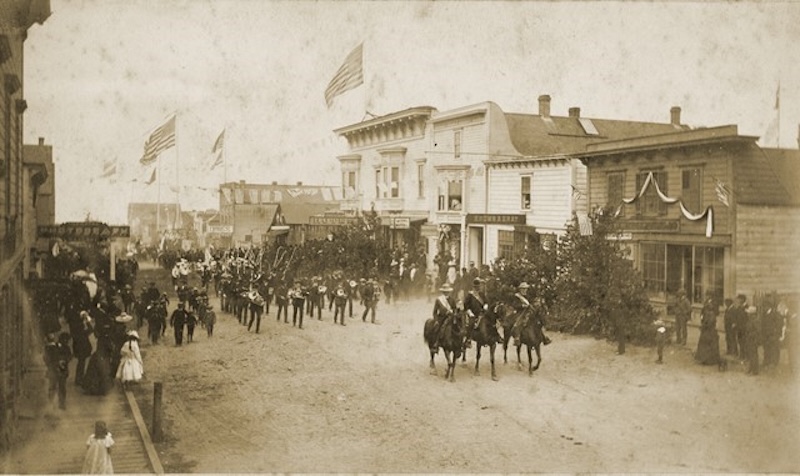
The 1883 July 4th parade proceeds east on Main Street.
The earliest photo we have of a July 4th parade in Mendocino dates from 1883, though there may have been some before that. Though Independence Day celebrations had taken place in cities across the country ever since 1777, July 4th did not become a federal holiday until 1870. After the trauma of the Civil War, there was a strong desire to extol the fact that one nation, conceived in liberty, had endured.
The 1883 photo shows an honor guard in the lead on Main Street, followed by a marching band and then groups of people walking behind banners, most likely of the many fraternal organizations that thrived here. Above the street many large American flags wave in the breeze atop tall “liberty poles” made from tree trunks attached to buildings or sunk in the ground. On both sides of the street people dressed in finery line the boardwalks, interspersed with cut evergreen trees placed along the route. The Mendocino Beacon informs us that the procession ended at the picnic grounds near Ford’s orchard [near today’s fire station east of Highway 1], where there was a picnic, reading of the Declaration of Independence, dancing, and plenty of guns. Dry-compounded gun powder was used to propel confetti and serpentine into the air.
We have photos and description of parades the following year, and for various years thereafter. Costumes grew in popularity, with many marchers decorated as Lady Liberty, Columbia the Gem of the Ocean, and Uncle Sam. In a 1908 photo, a few automobiles make their first appearances. There was a hiatus after that, presumably due to the fact that Mendocino voted to go “dry” in 1909, and the compulsory aridity withdrew a critical ingredient of the day.
The town got back to some sort of celebration in 1914, but it was “clean” fun and there was no parade. There was another break in the parades before and during WWI, and at some point (perhaps with the closure of the mill in 1939), the parades stopped for a long time. We do have several photos of a big parade in August of 1952 to celebrate the centennial of the town, but nothing of July 4th until 1976.
The Bicentennial bug was prevalent in the U.S. that summer, and Sally & Lee Welty were bit by it. Along with Barry Cusick, Heidi Cusick Dickerson, Susan Golden, and Jim & Brenda Coupe, they decided to organize a parade and picnic. The demographics and economy of Mendocino had changed considerably from what they had been, but old timers, artists and hippies all loved a parade.
As immortalized on page 1 of the Big River News of July 13, 1976, “The Bicentennial Fourth of July was celebrated along the coast amidst a spree of almost unparalleled warm summer weather. Around 1000 people witnessed an impressive parade through the town of Mendocino, followed by a ceremony and picnic at the vacant lot by the post office [Heider Field].” Not captured in that brief piece were some of the more colorful details. The Volunteer Fire Department provided a beer wagon for all the thirsty revelers. The picnic was a potluck, of course, in the best Mendocino tradition. And there were plenty of illegal fireworks.
The Grand Marshalls in this year’s parade, which steps out at high noon, will be some of the heroes responsible for the 1976 revival. They can still walk, but they prefer to be driven. The Kelley House will host its popular lawn party, with parade viewing, music by DJ Slysir, dancing, cornhole, and lots to eat and drink, alcoholic and non. It’s not likely to rain on this parade, so don’t miss it!
The Kelley House Museum is open Thursday-Monday, 11am-3pm. Visit the Kelley House Event Calendar for a Walking Tour schedule.