
Russell Brook Dam, a modest sixteen-foot structure on a tributary of Big River, was completed in 1907 by Alfred R. Johnston, a well-known logging boss and contractor. Built partly as a frame dam using logs, it stood one mile above the main river on Russell Brook. Smaller than many of the other dams on Big River, it was also the last dam Johnston built before his retirement from logging. Evidence of the dam remained visible as late as 1973, when his great-nephew, Francis Jackson, photographed its remains during his hikes to document Big River’s logging past.
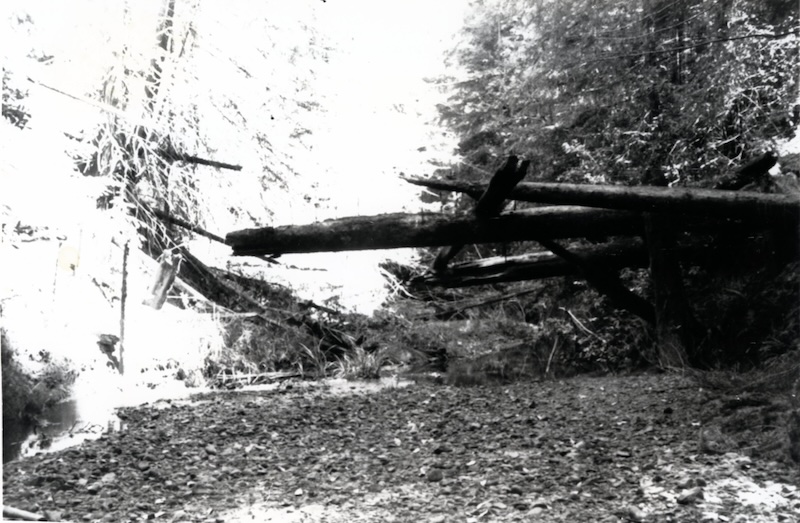
Remains of the Russell Brook Dam, 1973. (Photographer: Francis Jackson)
Jackson’s explorations along Big River began as a personal project. His goal was simply to create a map marking the locations of old dams to hang in his office. To gather this information, he hiked the riverbanks, taking photographs and recording the remains of dams such as Russell Brook. Along the way, he realized how little of the area’s logging history had been preserved, especially regarding the extensive dam system that once powered the lumber industry. His simple map project grew into a much larger historical study, eventually becoming the book “Big River Was Dammed” (out of print, but can be viewed at the Kelley House Museum Research Office). Through his work, Jackson preserved stories, technical details, and firsthand accounts that might otherwise have been lost with the passing of old-timers who once worked on the river.
The builder of Russell Brook Dam, Alfred Ryeson Johnston (1851–1929), played a central role in the history of logging on Big River. Born in Nova Scotia, he migrated first to Maine and later to California, settling on the Mendocino Coast in the 1880s. Johnston worked briefly for the Caspar Lumber Company before striking out as a logging contractor on Big River. Over the next three decades, he became one of the most enduring figures in the region’s timber industry. He built or oversaw at least seven dams, ran multiple logging camps, and in 1914 was the last man to use a bull team on Big River.
Despite his rugged profession, Johnston was remembered as a generous and hospitable man. In 1886 he married Sena Anderson, and together they raised their nephew, Charlie Buck, who had lost his mother at a young age. At the age of fifteen Charlie stood six feet and five inches tall. He grew up to become a champion log-bucker and was the original portrayer of the legendary Paul Bunyan at the annual Paul Bunyan Days celebration in Fort Bragg.
Johnston himself was respected by the men who worked for him, admired for his fairness, and beloved as a friend. After retiring in 1918, he and his wife settled at the Dunlap Ranch near Willits. Even in retirement, he stayed connected to his old life, riding his horse down to the river in 1923 to watch his old friend John Norberry build the North Fork Dam, the last dam built on Big River. Johnston passed away in 1929 at the age of seventy-eight, leaving behind a legacy woven deeply into the history of Mendocino’s redwood industry.
Celebrate Oktoberfest with a live homebrewing demo and beer tastings from Foggy Coast Brewers and North Coast Brewing Company. See how brewers turn grain into your favorite craft brew, pick up expert tips, and sip beer while taking in the stunning Mendocino Bay view from the Kelley House Museum lawn. Grab your ticket and raise a glass to the art of homebrewing! Saturday, September 13, 12 PM – 4 PM