
The Piccolotti Ranch, located fourteen miles up Big River from Mendocino, played an important role in the history of both the Mendocino Lumber Company and the town itself. Established by the company around 1860, the ranch was created to supply fresh food to the logging camps scattered throughout the Big River watershed. Vegetables, fruit, hay, and grain were raised to feed workers and livestock, and the ranch often served as a stopover for woodsmen traveling upriver. By the early 1900s, the ranch had become a vital source of sustenance for the camps, with foremen overseeing the harvest and shipments of potatoes, apples, and other produce.
In 1907, Pietro “Pete” Piccolotti immigrated from Crespano, Italy, in search of new opportunities. Three years later, his future wife Rosa Vagliana arrived from Italy as well. The two met in Fort Bragg, where Pete worked in the lumber yard and Rosa as a hotel chambermaid. They married and started their family, determined to provide a better life for themselves and secure an education for their children. By 1917, Pete was employed as a tie maker for the Mendocino Lumber Company, and following the death of ranch manager Harry Steudeman in 1918, he was promoted to foreman of the Lower Ranch. From then on, the Piccolottis lived on the ranch, raising their children in a remote and hardworking environment.
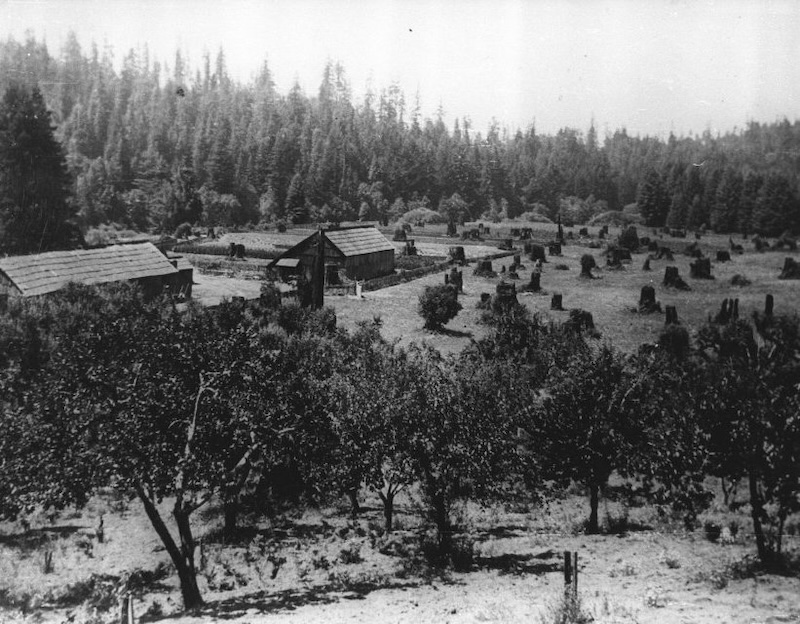
Piccolotti Ranch looking southwest from the orchard, 1931. (Piccolotti Collection)
Life on the ranch was not easy. The house had no electricity, refrigeration, or telephone service, and the children walked four miles each way to attend school in Melbourne or to catch the bus to Mendocino High School. Historian Francis Jackson later estimated that by the time the Piccolotti children graduated from high school, each child had walked more than 7,000 miles to and from school. Despite the challenges, Pete and Rosa raised six boys and two girls who grew up immersed in the rhythms of ranch life. Their youngest daughter, Alice Piccolotti Ivec, later shared vivid stories of her childhood: fording the river, tending vegetables, and living in close harmony with the land.
The ranch soon became known locally as “Piccolotti’s.” Under Pete’s management, the ranch provided the residents of Mendocino with fresh, locally grown vegetables, while continuing to supply the logging camps with food and hay until the Mendocino Lumber Company closed in 1938. Pete then leased the property and ran it as his own commercial operation, hauling truckloads of corn, potatoes, tomatoes, and other vegetables into town. The Mendocino Beacon regularly reported on his deliveries, noting how eagerly townsfolk awaited his produce. “We don’t know what we’d do without Pete,” the paper declared in 1925.
After nearly four decades of running the ranch, Pete retired in 1954, and he and Rosa moved into Mendocino. Their story, like that of many immigrant families, reflects the resilience and determination it took to carve out a life on the rugged Mendocino Coast. Today, the legacy of the Piccolotti Ranch endures as a testament to hard work, family, and the ties between land and community.
The exhibit On Tap at the Kelley House is open until September 29th! Come learn about the history of brewing on the Mendocino Coast. You can also check out the companion book on sale in the museum and on the Kelley House website. The museum is open Thursday-Monday 11am-3pm.