
On March 4, 1933, the United States banking system collapsed. Citizens could not retrieve their deposits and the panic that ensued affected everyone. Large banks reopened first, while some smaller banks like those on the Mendocino Coast never reopened. Many jobs were lost in the coastal lumber industry, and the Study Club felt the impact from both these events as many families left the area in search of jobs.
Throughout the Depression years the Study Club focus was on local needs. Club members supplied food and clothing to families and individuals, donated to the Dental Fund in the Mendocino Schools, and sponsored a baby clinic. In 1936, the topic of starting a kindergarten was discussed but abandoned because there weren’t enough children in the school district. The Club ended the annual children’s Christmas party that year for the same reason.
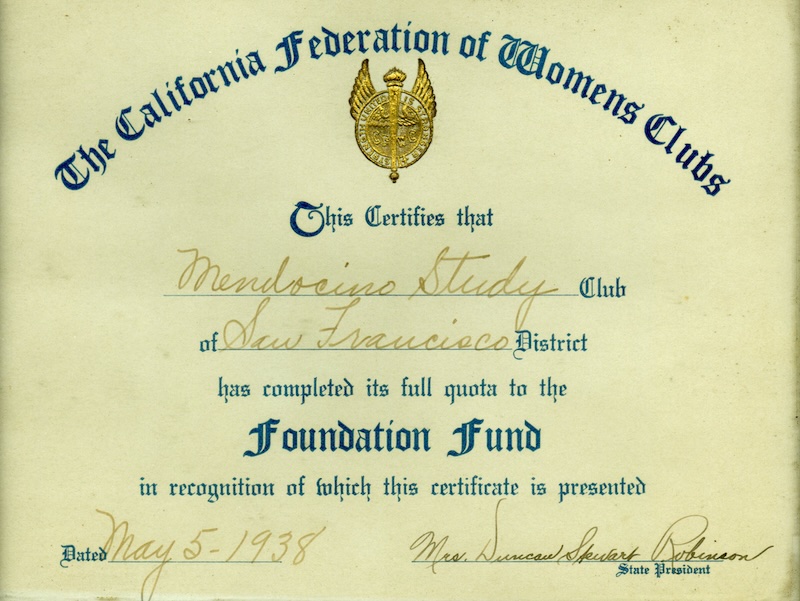
Certificate awarded to the Mendocino Study Club from the California Federation of Womens Clubs in 1938.
In 1937, Club members voted to hire a man to dispense with garbage and ashes and chop kindling for Club use, chores the ladies had been doing themselves. The following year, the Mendocino Lumber Company was absorbed by the Union Lumber Company, and the Club lost the use of their meeting rooms. At the fall meeting, the Club voted to write a thank you letter to the Mendocino Lumber Company for the use of their building for fourteen years at a low rent, and the last meeting there was held in October 1938.
The meetings were moved to Mrs. MacCallum’s Hall, originally called Kaze Hall. It was owned by Daisy MacCallum, a member and former president of the Study Club. Rent was $6.00 a month plus the cost of lights. The building had previously been used as a community recreation hall. A one-lane bowling alley became a gentlemen’s billiards hall, and there were stacks of large tabletops and wooden sawhorses that could be set up for banquets. The old three-foot wooden candleholders were often used for lighting. These amenities served the Club well when the rooms were offered as an emergency hospital, used for children’s clinics, a weekly Red Cross sewing room, Civil Defense Headquarters, a military hospitality house, draft registration, and many other war-time services. In 1950, Mrs. MacCallum had the building remodeled and renamed it Kelliowen Hall, a combination of her own and her mother’s maiden names.
For training and security prior to and during World War II, military servicemen were stationed on the coast in barracks at Point Cabrillo Light Station, the Mendocino Woodlands, and Russian Gulch Park. In February 1941, each Club member donated fifteen cents to purchase Bibles and Testaments for the boys in Army Training Camps. In the December meeting minutes: “War has brought many more servicemen into our locality… the Club might be able to provide recreation or entertainment for the men.”
Small children were cared for in a nearby room while their mothers attended classes in home nursing, knitting and sewing. In March, it was reported there were 256 names of civilians ready to do their share of civilian defense work, and that members were to supply cookies for soldiers baked at home since the Club couldn’t obtain a sugar ration. The following year members paid for wood used for heat at the Red Cross weekly meetings.
In October 1943, the Club embarked on a project to raise funds for the National War Fund through the California War Chest, Inc. They “adopted” a veteran from Fort Miley’s Veterans Hospital, and later each member made up a Christmas package for a wounded boy in the hospital.
In early 1944, members wrote Congressmen asking for support of the Federal Aid to School Cafeteria Lunch Program, and the secretary wrote a letter favoring the use of the Mendocino Woodlands for a convalescent camp for service men. Due to gas rationing, members were unable to attend the county Women’s Federated Clubs Convention in Ukiah but volunteered to make a trip to Santa Rosa to donate to the blood bank because gas was provided.
There was a critical shortage of nurses during WWII, and Congress passed the Bolton-Bailey Bill, a scholarship program for Cadet Nurses. The Federation took up the cause, and in 1943, the Mendocino Study Club embarked on a scholarship program that remains one of the Club’s major projects. With the end of the war in 1945, the Cadet Nurse Program was discontinued, and the Club began looking for a local girl who will take a regular nurses’ course. In 1946 Dolores Stenback (Lemos) was given $100 but changed her major from nursing to teaching and returned the money. In 1948, both Billie Mae Larsen and Patricia Dellingham did finish the nursing program. The Club expanded the search to Fort Bragg and eventually expanded the scholarship requirements to include teaching candidates.
— Excerpted from Ladies of the Afternoon 1908-2008: the First 100 Years of the Mendocino Study Club by Jean Droz and Janet Barnes
𝘚𝘢𝘯𝘵𝘢 𝘸𝘪𝘭𝘭 𝘣𝘦 𝘢𝘵 𝘵𝘩𝘦 𝘒𝘦𝘭𝘭𝘦𝘺 𝘏𝘰𝘶𝘴𝘦 𝘚𝘢𝘵𝘶𝘳𝘥𝘢𝘺, 𝘋𝘦𝘤𝘦𝘮𝘣𝘦𝘳 6𝘵𝘩 𝘧𝘳𝘰𝘮 3:30-4:30𝘱𝘮. 𝘊𝘰𝘯𝘴𝘪𝘥𝘦𝘳 𝘵𝘩𝘦 𝘒𝘦𝘭𝘭𝘦𝘺 𝘏𝘰𝘶𝘴𝘦 𝘣𝘰𝘰𝘬𝘴𝘵𝘰𝘳𝘦 𝘧𝘰𝘳 𝘺𝘰𝘶𝘳 𝘩𝘰𝘭𝘪𝘥𝘢𝘺 𝘴𝘩𝘰𝘱𝘱𝘪𝘯𝘨 𝘯𝘦𝘦𝘥𝘴! 𝘞𝘦’𝘳𝘦 𝘰𝘱𝘦𝘯 𝘛𝘩𝘶𝘳𝘴𝘥𝘢𝘺-𝘔𝘰𝘯𝘥𝘢𝘺 11𝘢𝘮-3𝘱𝘮.