
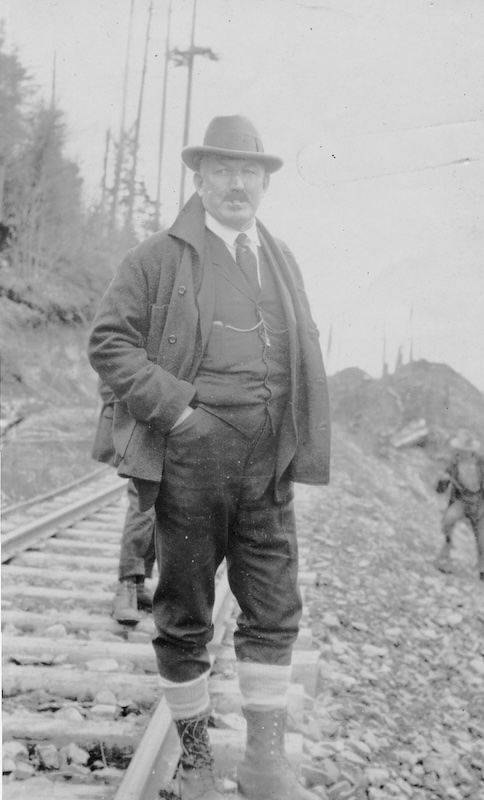
Ed Boyle, Woods Superintendent for the Mendocino Lumber Company, 1928. Kelley House Photographs.
Thomas Edward “Ed” Boyle was one of the most respected figures in the Mendocino Coast’s lumbering history, a man whose life was shaped by the redwoods and who, in turn, helped shape an entire era of logging on Big River. Born in Albion on December 4, 1866, Ed was the second of eight children raised by Thomas and Mary Boyle. His father, an experienced river driver for the lumber industry in New Brunswick and Maine, brought his skills to California in 1863, settling in Albion. Ed grew up immersed in the logging world, learning the trade under his father’s guidance in the nearby forests.
By age 15, Ed was already working in the woods, earning just $15 a month. He quickly rose through the ranks and, within three years, was driving ox teams for $100 a month, an excellent wage at the time. He joined the L. E. White Lumber Company in Greenwood (now Elk), where he was soon promoted to logging camp foreman. Two years later, he became woods foreman at the Little Valley Lumber Company in Cleone under John S. Ross. When Ross took over as Superintendent of the Mendocino Lumber Company in 1902, Ed followed, taking on logging contracts until 1905, when he sold his equipment and accepted the role of Woods Superintendent, a position he would hold until his death nearly 25 years later.
In 1906, Ed and his wife, Joanna, purchased the Justin Packard House (built in 1882) on Main Street in Mendocino, now home to Pamela Hudson Real Estate. The house remained in the Boyle family for nearly a century before being sold in 2005.
As Woods Superintendent, Ed oversaw nearly every aspect of the Mendocino Lumber Company’s operations on Big River during a period of rapid technological change, from the last days of bull teams to the introduction of steam yarders, tractors, and an expanded railroad system. He established several logging camps, the largest and most important being Boyle’s Camp, a bustling community of up to 200 workers and their families, complete with a cookhouse, school, and railroad hub. The camp became the center of logging activity on Big River and a vital part of the region’s economy.
Known for his calm authority, practical knowledge, and hands-on leadership, Ed was always the first to arrive when trouble struck, whether he was needed to repair a damaged dam, recover a locomotive after an accident, or clear a log jam deep in the woods. He worked closely with logging contractors, embraced innovation, and earned the respect of all who worked with him. Remembered as a man who “led by doing,” Ed inspired loyalty and trust among his crews.
When Ed Boyle passed away in December 1929 after a brief illness, the loss was deeply felt across Mendocino County. Despite poor weather, friends and colleagues traveled from far and wide to attend his funeral at the Mendocino Catholic Church. He was laid to rest at Holy Cross Cemetery in San Francisco, but his legacy endures in the history of Mendocino’s logging country.
Summer Exhibit! ON TAP AT THE KELLEY HOUSE: The History of Brewing on the Mendocino Coast traces the deep roots and rich stories behind one of Northern California’s most spirited industries—from the small breweries that served the local lumber workers to the craft beer renaissance that put Mendocino on the national brewing map. Thursday-Monday, 11AM – 3PM.