
Nancy Mary Flood was born October 26th, 1885 in a woods camp at Fred Halmke’s sawmill site two miles up Greenwood Creek from the ocean. The town of Greenwood was nonexistent at the time. Cuffey’s Cove, a few miles north on the coast, was where ships came to load lumber.
Nancy Mary was named for her grandmother Flood but the name soon softened to Nannie May and later to Nannie. Her father, William Henry Flood, came from Surry, Maine in 1872 and had been working in the logging camps along the coast as a bull-puncher, driving the bull teams hauling logs to the creeks to float them to the sawmill. When and where William Henry Flood and Rosa Mary Watkins, Nannie’s mother, met is not known. Rosa’s parents came from England to Canada. Rosa was born in Ottawa, Ontario in 1858. Rosa and William’s marriage is recorded in the Mendocino Presbyterian Church Register on January 28th, 1885. Reverend James L. Drum conducted the ceremony with Mrs. Drum as one of the witnesses and Rosa’s good friend Euphemia Thompson as the other.
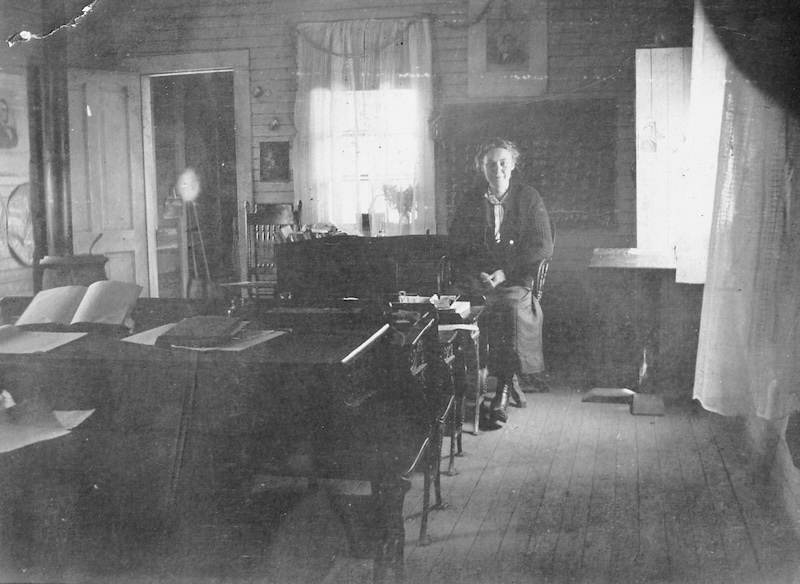
Nannie Flood Escola in her classroom at the Ellison School, 1909. (Gift of Linda Mechling)
Around 1891 the family moved to Glen Blair, where William was employed as Woods Boss for the Pudding Creek Lumber Company (later named Glen Blair Lumber Company). Although Nannie started school at Glen Blair, she was there only a few months when her folks decided to move to Mendocino, where there would be better schooling for their children. A Mendocino Beacon item published on June 4th, 1892 states “W.H. Flood has moved his family down and is occupying one of Mose Greenwood’s cottages.” The house was on Pine Street. Soon they moved further east on Pine Street to a roomier two-story house owned by the Baskerville brothers, John, Peter and James. When the last Baskerville died, he willed the house to Rosa Flood.
Nannie’s school days were spent in Mendocino, until 1906 when she enrolled in the San Jose Normal School. She graduated in 1908 and came back to teach in Mendocino county for the next six years. Her first school was at Counts, a tiny one room school in Anderson Valley. Ellison District School was her second teaching assignment. Her last teaching role was at the Little River School. This assignment lasted for two years until her marriage.
The Beacon provides another bit of news about Nannie on November 9th, 1912. “Miss Nannie Flood was the first woman in Mendocino to cast a vote for President of the United States. Miss Flood cast her ballot a few minutes after 6 o’clock and before going to Little River to open her school.” California voted for women’s suffrage nine years before it became federal law.
All was not joyous on the day of Nannie’s wedding to John Escola in 1914. John’s father had died shortly before, and Nannie’s parents did not approve of her marrying a woodsman and a Finn. The couple had waited six years to be married and felt that was long enough. They had met while Nannie was teaching at Ellison District and boarding at John’s brother’s home.
Nannie and John lived first at the tie camp near Little River, later in the Albion woods, once near Comptche, and wherever else jobs opened up. Like all woodsmen’s families, they moved to town for the winter. On January 4th, 1919, the Beacon reported “John Escola and family, who have been at Keene Summit for the past several months, have moved into the Flanagan cottage on Pine Street.” This became their favorite town house, and in 1924 they bought it from Flossie Flanagan Anderson, daughter of John Flanagan who built it in 1889.
When her daughter Hazel was still a toddler in 1926, Nannie went back to her Ellison District school after an absence of 12 years from a schoolroom. John was working in the area. The mandatory number of children to keep a school open was five, and John and Nannie had four of school age. During the week while Hazel (Tillie) stayed with her grandmother Flood, the rest of the family lived in the Ellison District schoolhouse in the living quarters provided. The children were taught by their mother. Attendance varied, some years there were as many as 35 students, depending on how much logging activity there might be. Most weekends the Escolas came back to their home in Mendocino. This arrangement lasted around 10 years. As the Escola children finished their elementary education they attended Mendocino High School.
This piece was excerpted from the Spring 1974 Mendocino Historical Review. The Kelley House Museum is open Friday-Sunday 11am-3pm. For a walking tour schedule, visit the Kelley House event calendar.