
Edited by Averee McNear
It’s hard to imagine a time when there wasn’t abundant access to books through schools, libraries, and bookstores, if a person could even afford books! In the late 19th century and early 20th century, public libraries began opening nationwide, many boasting the Carnegie name in honor of the Scottish American industrialist Andrew Carnegie, who donated a significant sum of his fortune to building libraries. However, on the Mendocino coast, as with many other rural places, libraries were community endeavors. In Check It Out! A History of Mendocino Coast Libraries, Karen McGrath, Katy Tahja, and Sarah Nathe delved into the history of the many libraries here. The following is an excerpt from Chapter 3: Mendocino’s Temperance Libraries, written by Karen McGrath.
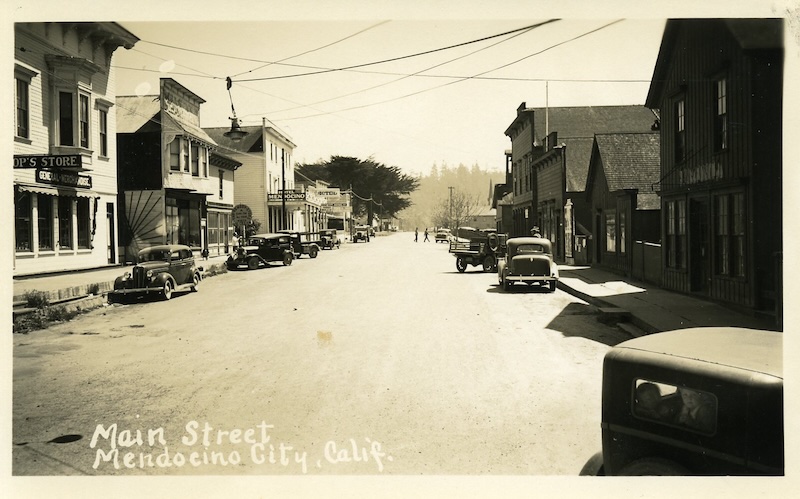
Mendocino Main Street looking east, circa 1936. Templars Hall is on the far right, behind the flagpole.
While there was a reading room in the Odd Fellows Hall on Ukiah Street in the late 1870s and 1880s, Mendocino’s first public library came a little later. Called the Free Reading Room, it opened in April 1883 on the second floor of the Templar’s Hall, one of the now-gone buildings owned by the Mendocino Lumber Company, across from what is now the Mendocino Hotel.
Ed Fairfield, a skilled cabinet maker and its first librarian, crafted a bookcase to display an assortment of donated books to be read in the room. Racks held newspapers and magazines from all over California, the West, and the eastern U.S.—veritable portals to worlds beyond this remote coastal town.
The organization behind the first library was the Independent Order of Good Templars (IOGT) a forceful group that advocated a temperate life—one without alcohol. Along with the Woman’s Christian Temperance Union (WCTU), the lOGT played a major role in making Mendocino City a “dry” place in 1909.
For temperance groups and other civic organizations, reading rooms and libraries were seen as a positive way to keep the town’s many single men out of the saloons. The Templar’s room was usually open every day in the afternoon (a time ‘convenient for the ladies’) and also for several hours in the evening for working men.
Despite its attractive qualities, this reading room endured only a few years. Like so many of the public reading places that followed, it suffered from a lack of financial resources to pay staff and maintain the collection.
After a few years, another free reading room opened in the Masonic Hall, supported this time by the WCTU. It was patronized by so many that a notice published in the newspaper requested children be kept at home during the evening hours. But it, too, lasted only a few years.
Mendocino’s next reading room was sponsored in 1895 by the Christian Endeavor, a Protestant youth fellowship, again in the IOGT Hall. This group took a more fun-loving approach to its mission and put on regular entertainments featuring music, literary recitations, and farcical plays to fund the librarian and purchase the periodical subscriptions. However, by 1905, the Beacon was reporting that Mendocino was again in need of a good reading room.
Three years later, another group and another library association emerged, this time backed by the new Mendocino Library Association. The executive committee was composed of members from the WCTU and two associated religious youth groups: the Baraca young men and the young ladies of Philathea.
The MLA negotiated a lease at a new location for the library in a structure that once stood immediately west of the Kelley Pond. In renovating it, they no doubt took satisfaction in turning the former saloon into a space more suitable for the public’s betterment. Like the Christian Endeavor before them, they put on plays and concerts to benefit the library, but their funding strategy also included patron subscriptions to pay for magazines and newspapers. The MLA also had an arrangement with the California State Library to receive a rotating stock of literary volumes every quarter.
A few months after its opening, a Mendocino Beacon article reported that the library was well patronized and that the number of book borrowers was increasing. One year after this new library started, the temperance movement the WCTU and others had been championing for decades finally had its desired effect: Mendocino City’s saloons were closed in 1909 when citizens voted to ban the sale of alcohol. Then there arose an even more pressing need to provide recreation for the men who might otherwise have been finding their way to the “wet” communities that remained up and down the coast.
Check It Out! A History of Mendocino Coast Libraries is for sale at the Kelley House Museum and on our website. Celebrate Oktoberfest with a live homebrewing demo and beer tastings from Foggy Coast Brewers and North Coast Brewing Company. See how brewers turn grain into your favorite craft brew, pick up expert tips, and sip beer while taking in the stunning Mendocino Bay view from the Kelley House Museum lawn. Grab your ticket and raise a glass to the art of homebrewing! Saturday, September 13, 12 PM – 4 PM.