
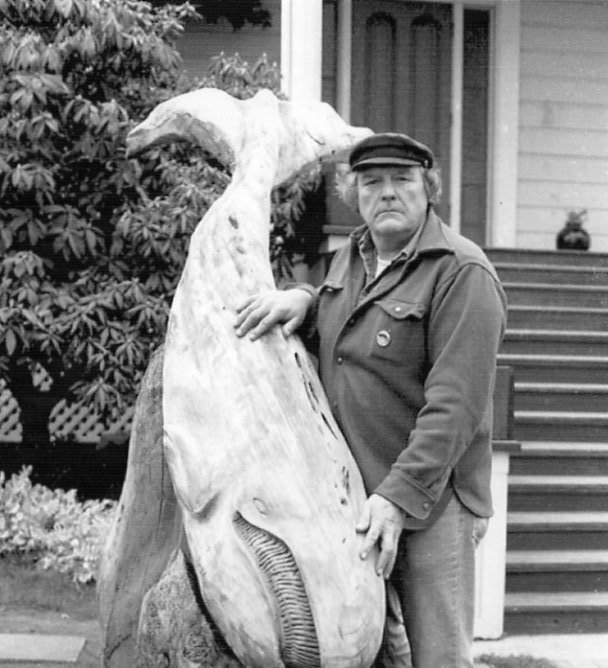
Byrd Baker and his whale sculpture, 1976. (Photographer: Nicholas Wilson, Gift of Bruce Levene)
On March 15, 2025, the Kelley House Museum hosted four original members of the Mendocino Whale War Association: Heidi Cusick Dickerson, Barry Cusick, Sally Welty, and Lee Welty. Also present was Shana Hadley, granddaughter J.D. Mayhew, who was a founding member of the Mendocino Whale War Association. The panel discussed their experiences participating in the Whale War and organizing the first Whale Festival in 1976. The panel is available to watch on the Kelley House Museum YouTube channel. The video also includes a discussion with Katherina Audley of the Noyo Center for Marine Science.
The panel began with Heidi Cusick Dickerson reading an excerpt from an article Byrd Baker wrote in 1977 for Mendocino Past and Present magazine. She says Byrd is where it all started. Byrd wrote, “Seeing the sperm whales become extinct, and then the blue whale is going to become extinct in my lifetime, makes me rot inside, because this is the largest of all God’s creatures. Why is it that at 53 years of age, I’m now pounding and yelling ‘This is wrong!’ I asked myself, ‘Byrd, why did you let this happen in your lifetime?’ I guess it was ignorance, total ignorance. Now I’m not the one by any means who originated the idea of stopping killing whales. Thousands of people have said it much better than I can, but the thing is that it came home to me that I could not conduct my life any longer like it was. I had to do what I had to do, and I had to do it right away.
“Here in Mendocino, a whole town was boycotting Japanese products. They had never done that before. I went directly to the merchants and asked how they felt about Japan and Russia killing 85% of the whales. They wanted to know how they could help. All of the merchants began to boycott Japanese products and told their wholesalers and manufactures they would no longer make purchases until the killing of the whales stopped. The whole town joined in the boycott. For many years, people fought to have a 200-mile offshore limit put into effect. Many industries, including the tuna industry, did not want one. The Mendocino Whale War received coverage in newspapers, radio, and television across the United States. We made it clear to the country that the Russians were fishing 12 miles off the United States and even closer in bad weather. We documented the fact that Russian trawlers drag 300-foot-long nets and operate 23 hours a day. We counted 35 of them in a small area, and we had their boat numbers and names. Because of the efforts of the Mendocino Whale War, along with Greenpeace and others, the 200-mile limit went into effect in 1976. So you see, you can dream and you can right a great wrong by getting involved.”
On Saturday, March 7th, the Kelley House Museum is hosting a screening of The Boy Who Talks to Whales. Barry Cusick will introduce the film, which was released in 1975 at the height of environmental activism. The film follows 15-year-old Andy and his Uncle Will as they embark on an arduous search for Gigi, a gray whale they believe communicates with humans. Uncle Will is played by local activist Byrd Baker, whose real-life crusade to “Save God’s Whales” helped spark the anti-whaling movement on the Mendocino Coast. Filmed over 50 years ago, The Boy Who Talks to Whales serves as a vivid visual archive of Mendocino, and many viewers will enjoy the “then and now” look at the town and coastline. Limited seating is available, so advanced purchase of tickets on the Kelley House website is recommended. The film begins at 4pm.
Come view the Mendocino Whale War pop-up exhibit, on view during March. The Kelley House Museum is open Friday-Sunday, 11am-3pm. Visit the Kelley House Museum website to purchase tickets for The Boy Who Talks to Whales screening.