
SOUTH of MAIN – Discovering the Lost Buildings of the Mendocino Headlands is available on the Kelley House Museum website, under the Exhibits tab. The exhibit takes visitors on a walk back in time, when the south side of Main Street was lined with more than twenty buildings that are no longer there. https://www.kelleyhousemuseum.org/exhibits-south-of-main/
The post office, the meat market, a photo gallery, Chinese stores, jewelry shops, water towers – all were once a part of the essential fabric of downtown. Storefronts occupied both sides of Main Street to form a two-sided corridor of commerce.
Today, the land to the south is clear of buildings, and the view as we walk down the street is unobstructed out across the Headlands State Park to the open ocean. What happened?
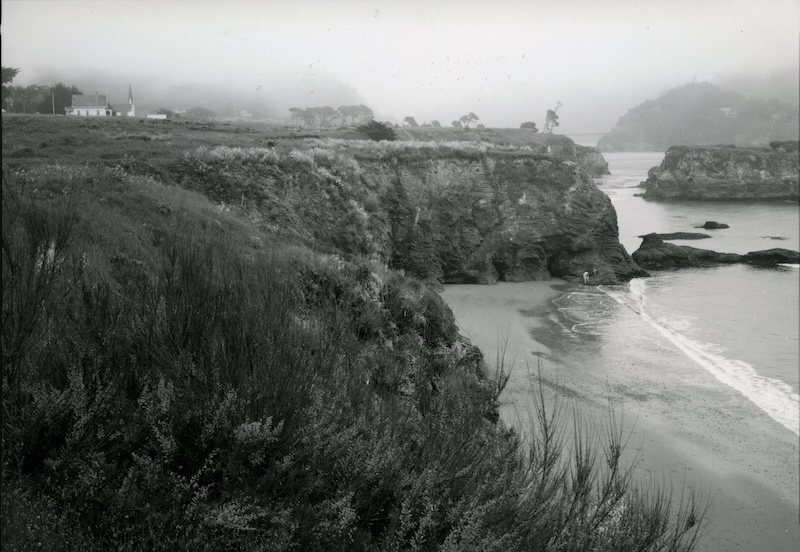
Mendocino Headlands and Portuguese Beach, circa 1980.
We’re going to let Chuck Bush explain the unique sequence of events that created the Park once the Main Street structures were gone. Chuck wrote the following piece for the June 24, 1993 Mendocino Beacon.
In the late 1950s when the Zachas were developing the Mendocino Art Center and adding a new dimension to the town, Auggie Heeser gave his land that was west and north of Heeser Drive to the State Fish and Wildlife Department, so people could go out on the headland and fish until the end of time.
That event seems to mark the beginning of the efforts to keep the flavor of Mendocino as it had developed since the 1850s. It was the first major preservation effort. In 1960 that land was transferred to the California Department of Parks and Recreation.
In the late 1960s, the Boise Cascade Company purchased Union Lumber Company of Fort Bragg and acquired over 70 undeveloped acres of headland south of Main Street, along with Big River beach. That company had, at other locations, built company housing on like property, and the idea that something similar might be developed here aroused the townspeople.
The Mendocino Headlands Park Committee was set up, led by Emmy Lou Packard and later by Mildred Benioff. It searched for, and found, an alternative. A swap was arranged so that the headland and beach property became state park land, and in return the lumber company received timberland inland.
However, State Park Director William Penn Mott also felt that it made no sense to preserve the coastline if the town might be allowed to become an ugly eyesore. The first action taken was to submit, in 1970, the forms necessary for Mendocino to be accepted onto the National Register of Historic Places. Significant in the proposal were pictures showing the town’s unique architecture. In 1971 the town was designated a National Historic District.
Second, the Headlands Park Committee, with the support of state and county officials, created an Historical Preservation District Ordinance designed to protect the character and heritage of Mendocino.
An enormous amount of time and effort went into this project, which was finally approved by the County Board of Supervisors to become effective March 9, 1973. The ordinance set up our two historic zones, established the Mendocino Historical Review Board, provided standards and procedures for review, and penalties for violation.
In the early 1970s, Al Nichols, who inherited his cousin Auggie Heeser’s properties upon his death, sold the acreage located inside Heeser Drive loop on the headlands to the Department of Parks and Recreation. In 1972 the Coastal Commission was organized and four years later the California Coastal Act was passed by the legislature, mandating the development of sound coastal management plans. So today [1993] the coastline of the Mendocino Headland and the entire western end of the Headland are protected as state park land, and will remain preserved in a natural state, hopefully forever.
Conservation Forever: 50 Years of Mendocino Land Trust is now open at the Kelley House Museum! The opening reception for Conservation Forever takes place this Saturday, April 11th at 4pm at the Kelley House. This exhibit runs until June 1st, 2026. The Kelley House Museum is open Thursday-Monday, 11am-3pm.