
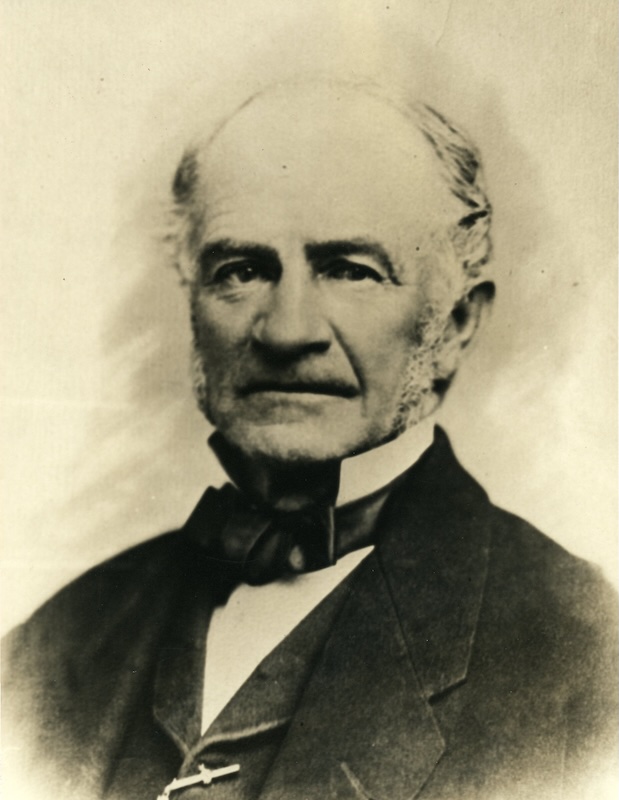
Captain David Lansing, circa 1870.
David Frederick Lansing was born September 14, 1809, in Albany, New York. From the Albany genealogical records, it appears that the original Lansing (also spelled Lansingh or Lansinck) came to New York from Holland around 1650. Like many New England youths, David went to sea at an early age. His first long voyage was on board a whaler, which spent three years in the south Pacific. The young Lansing loved life at sea. He proved to be quite an able seaman and, being of some intelligence, became a Captain in his early twenties. He made many voyages around Cape Horn and earned moderate success as a whaler.
In 1849 Captain Lansing and his family, wife Charlotte Whipple and two daughters Mary and Charlotte, boarded the Hanna Sprague in New York harbor and sailed around Cape Horn to San Francisco. They arrived on November 12, 1849. The entire voyage took 175 days to complete, consisting of 18,000 nautical miles.
According to records kept on the ship, a committee composed of Alfred Wheeler, Samuel J. Bookstaver, Charles F. Clarke, and Maurice Twiss presented Captain Lansing with a resolution saying that he “combined the courtesy and generous impulses of a manly heart and the skill and sagacity of a seaman perfect in his profession … while we are about to separate from him, we tender to him our earnest thanks as an expression of our full satisfaction, and our best wishes for his future welfare and prosperity.” Not much else is known about Captain Lansing or his family during the years 1849-1852, other than Charlotte giving birth to Francesca “Fanny” Lansing sometime between 1851 and 1852.
In 1852, life for the Lansing family changed considerably. David became Captain of the brig Ontario, a 557 ton ship built in New York in 1812 by A&N Brown. The Ontario was to carry machinery owned by Henry Meiggs for the building of a sawmill at Big River, later known to be Mendocino City. E.C. Williams, William H. Kelley, and J.E. Carlson were all on the ship. Meiggs employed Lansing to pilot the ship to Mendocino Bay and remain as supervisor of shipping at the new undertaking.
Meiggs ran into financial difficulties in 1854 and left the country. Five men, Aldred Godeffroy, William Sillem, John Freundt, J.B. Ford, and E.C. Williams, reopened the mill under the name Mendocino Saw Mill the following year. They retained Captain Lansing as harbor master and shipping superintendent until 1874. Walter Jackson states in The Doghole Schooners that Captain Lansing spent many days in a rowboat locating dangerous underwater rocks and reefs in Mendocino Bay and marking them as menaces to navigation. Lansing was instrumental in saving the lives of many from a watery death when they happened to be unlucky enough to be aboard a vessel that had gone up on the beach or was being dashed to pieces against the rugged cliffs surrounding the Bay. Captain Lansing often remarked that he had witnessed the deaths by drowning of at least fifty persons in the Bay as the result of shipwrecks, capsizing rowboats, falls from cliffs, or from being washed off the rocks while fishing.
Shipping served as the most efficient lifeline to the Mendocino coast prior to the railroad age. Lumber, agricultural products, passengers, and freight were shipped between San Francisco and Mendocino by means of schooners. Lansing was the first to supervise this operation out on the Point.
To date no records remain containing explanations of day-to-day operations on the Point. Captain Lansing and his associates left us precious little information expounding on the excitement or monotony of transferring lumber, goods, and passengers out from the Point to the schooners. It seems, though, that under the supervision of Captain Lansing the operations were carried out efficiently.
When he arrived in Mendocino, Lansing’s plans included bringing his family up from San Francisco as soon as possible. He built one of the first houses in Mendocino. Because the lumber cut by the mill in Mendocino was green rough stock, Lansing considered it unsuitable for the construction of a home for his family, so he purchased the lumber for his house in San Francisco. After Charlotte and David died, in 1867 and 1877, respectively, their daughter Julia lived in the family home for some time. Julia married James Morrow in 1874, and he intended to build an addition to the house and convert it into a hotel. The Morrows moved away from Mendocino but returned in March 1888. Today the house [on the northeast corner of Main and Howard Streets] is still standing.
This piece was excerpted from the Mendocino Historical Review, Spring 1985. The Kelley House Museum is open Friday-Sunday 11am-3pm. Visit the Kelley House event calendar for a walking tour schedule.