
Mendocino is a wooden place. No surprise there, since the town’s economy was founded on trees. The lumber mill provided plentiful building supplies for homes, stores and sidewalks.
What is unusual is how much of it is STILL wood. The historic district’s design guidelines do not recommend plastic. Fences are mostly wood pickets and planks, not vinyl. Signs are wooden. Windows, doors and siding are all made from milled trees.
In addition to sawn and planed lumber, there was split stuff – wood shakes and shingles – used to clad the exterior of buildings. Shakes were readily available roofing materials that could last for decades.
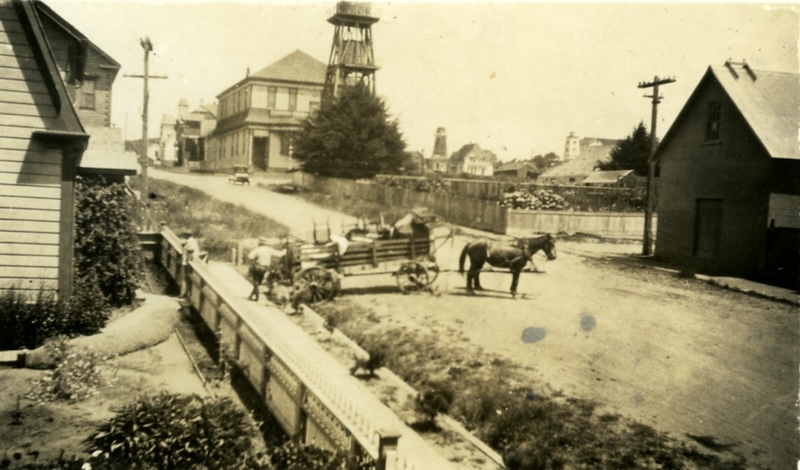
Kasten Street at Albion Street in Mendocino, c. 1912. A Jarvis & Nichols storage barn is on the right, constructed in 1903 with corrugated iron siding and roof after a fire burned a previous storage building. (Gift of Victor Hornbeck)
However, wood burns easily, even in a damp climate like that found on our coast. Which is one reason why you would think that non-flammable roofing materials would be readily embraced by local builders as they became available in the last part of the 1800s. After all, it’s the flying brands landing on flammable wood roofs that spread the devastating flames from building to building.
Recently, I was examining our ever-useful Sanborn Fire Insurance Maps. We have access to seven editions for Mendocino, spanning 1883 until 1929. The maps not only tell us what the buildings were used for, which is how we traced the history of our exhibit, South of Main – the Lost Buildings of the Mendocino Headlands. They also reveal what materials were placed on every single roof. Even the sheds.
The vast majority of buildings in Mendocino were built with wood shake roofs, but around 1890 corrugated iron sheets can be seen on maps and photos. This material, also called tin roofing, had many promising attributes. It was non-flammable, it was lightweight, requiring a less-heavy wood support structure, and it could cover a given square footage quickly – an especially handy feature for locations that are hard or dangerous to access.
This new material was used at first to roof the tall water towers that were springing up all over town. These were valuable, essential structures that were hard to construct. Three of the four lovely houses located on “Bankers Row,” along the north side of Little Lake Street, had metal roofs on their elaborate water tank houses in 1890, including the very tony Blair House built in 1888. Yet, by 1898 only the Packard House water tower near the corner of Kasten and Covelo Streets still had a tin roof, which was still there as late as 1929. The rest were re-roofed with shakes.
Except for a handful of buildings, forty years later in 1929 there were still few metal roofs or walls shown on Mendocino’s maps. One of these exceptions was a tin-walled and tin-roofed group of warehouses built by Jarvis & Nichols and located on and near the corner of Albion and Kasten Streets. Built after a 1903 fire destroyed the former buildings, they were there until at least 1961 when Bill Zacha renovated the corner building for Dorr Bothwell’s studio (now Queen Bee clothing).
The historic maps tell us Mendocino preferred wood – then, as well as now. Composition or metal roofing materials were relegated to non-visible areas behind parapets, or used in potentially flammable industrial buildings, like those that repaired gasoline engines. Stores, houses and gathering places all had wood shakes. Which makes the very few tin roofs we still have quite special.
This article was originally written by Karen McGrath and published on February 6, 2020. The Kelley House Museum is now open for its summer hours, Thursday-Monday 11am-3pm. Come view Conservation Forever: 50 Years of Mendocino Land Trust! Visit our event calendar for a walking tour and event schedule.